
The trip you keep postponing
You cannot leave the shop, so you do not meet suppliers, customers or anyone new. The economics of that are unusually well documented, and so is the way out.
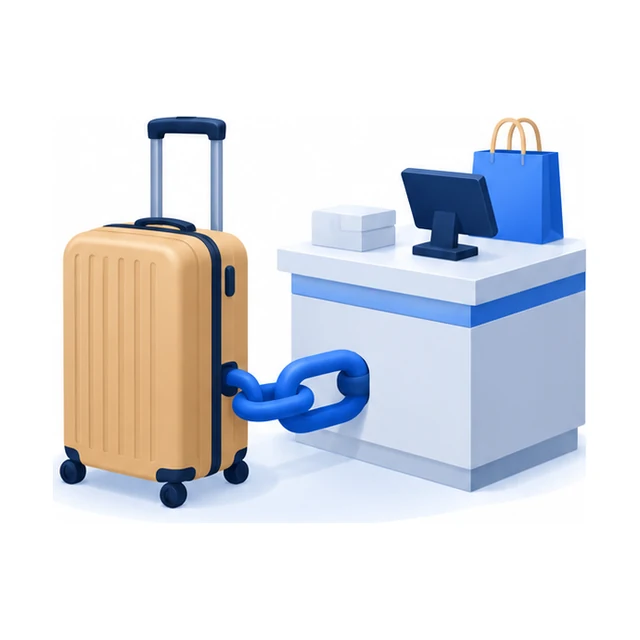
There is a supplier in Delhi who has been asking you to come and see the new range for two years. There is a customer in Vijayawada whose orders have been getting smaller since March, and you do not know why, because you have not sat in front of him. There is a trade fair in your own line that you have now missed four times.
You keep meaning to go. You have not gone, because if you go, who runs the shop?
That question has an answer, and it is not "trust your staff more".
What not going actually costs
The costs of staying put are real and share one inconvenient property: none of them ever appears on a profit and loss statement.
- The deal you did not make. The supplier's better rate, the extended credit, the first allocation of a line everyone will want by December — those go to the buyer who turned up. Not because he negotiated better, but because he was in the room.
- The customer drifting away. You find out he has moved to somebody else when the order stops. He decided months earlier. Somebody visited him and you did not.
- The thinking. This is the one owners under-rate most. You cannot see your own market from inside your own shop. Every good idea a business ever had about what to stock, what to drop and what to charge came from seeing something somewhere else.
Because none of those has a line in the books, they lose every argument against today's billing, which does. And they lose that argument again tomorrow.
The economics of this are unusually well documented

This is one of the most studied problems in development economics, and the findings are blunt enough to be worth knowing.
Start with the shape of it. Chang-Tai Hsieh and Peter Klenow, in the Quarterly Journal of Economics in 2014, compared how businesses grow over their lifetimes in different countries. In the United States the average forty-year-old plant employs more than seven times as many people as a plant under five years old. In India a forty-year-old plant is about 40 per cent larger than a young one.
The Indian business does not usually fail. It stops.
Why it stops is the subject of a second study, and this one will feel uncomfortably familiar. Nicholas Bloom and colleagues ran a field experiment across Indian textile firms, published in the same journal in 2013, and recorded something they had not gone looking for: in every single firm in the sample, only members of the owning family held real decision-making power over finance, purchasing, operations and employment.
The reason was not culture. It was practical. Owners were afraid that a manager allowed to buy yarn would buy it from a friend at an inflated rate and take a cut — and that if he did, the courts would be no help in getting the money back. So the firms grew as far as the family could personally supervise, and then stopped. The researchers put a number on it that is hard to forget: the number of brothers and sons of the leading director predicted the size of the firm about three times better than the quality of its management did. The best-managed firm in the study had exactly one plant, because the owner had nobody to send to a second.
Measured from another angle, in the American Economic Review in 2021: about 12.5 per cent of US employees are hired outside managers, against under 2 per cent in India — a gap the authors reckon accounts for around 11 per cent of the income difference per person between the two countries.
For most readers here the arithmetic is starker still. Government survey data puts roughly 85 per cent of India's unincorporated enterprises at zero hired workers, averaging about 1.7 people in all. "Everything runs through me" is not a complaint. It is a description.
Your fear is specific, and it is correct
None of the above is an argument that you are being unreasonable. It is the opposite.
Ask an owner what he is actually afraid of while he is away and the answer is never vague. It is a short list, and it is always the same list:
- A purchase entered at a rate nobody checked.
- Goods leaving the premises on a slip that was never matched at the other end.
- Discounts given that were never agreed.
- Cash collected today that arrives the day after tomorrow, or in a slightly smaller amount.
That is not paranoia. Every one of those has happened to somebody you know. We have written about these four at length in the controls every growing shop sets, and how each one gets tested, including a customer who traced a ₹40 lakh loss in goods moving between his own locations and ended up filing a police complaint.
So the fear is correct. The conclusion drawn from it — therefore I cannot leave — is the part worth examining.
What changes it is verification, not trust

Here is the finding from that Indian textile experiment that nobody quotes, and it is the most useful one in this article.
When the firms improved how information was collected and passed around, something happened that the researchers had not set out to produce: the owners began delegating more. They handed over decisions on hiring, investment and pay to plant managers they had not trusted with them a year earlier. Nothing about the managers had changed. What changed was that the owner could now see what they had done.
That is the whole mechanism. You do not need to trust people more in order to leave. You need to be able to check. Those are two different problems, and only one of them has a solution you can buy.
Two more studies make the point from opposite directions.
Pierce, Snow and McAfee followed 392 restaurant locations across 39 US states as monitoring software was rolled out (Management Science, 2015). Theft fell about 22 per cent — but revenue rose around 7 per cent, close to $3,000 a week per restaurant, a larger effect than the theft it prevented, and it came from the same staff behaving differently rather than from replacing them. Being visible did not merely stop people taking. It made them sell.
And from rural Rajasthan (American Economic Review, 2012): teacher absence in schools given a simple tamper-proof date-stamped camera fell from 42 to 44 per cent down to about 21 per cent. A different setting entirely, and shop staff are not schoolteachers — but the mechanism is the one you are worried about, and it is cheap.
Staying tuned without staying in

This is where your phone earns its place, and where most owners get it wrong in a specific way.
The instinct is to ask for everything: show me every bill, let me watch the day. That is not remote management. That is standing at the counter from further away, and it will ruin the trip you went to the trouble of taking.
What you want is the opposite — an arrangement old enough to have a name, going back to Frederick Taylor's Shop Management in 1903: you are told only when something crosses a line you set in advance. Everything normal stays silent.
In Stock2Track the alerts worth setting are the ones that map onto the four fears above:
- A bill above an amount you choose.
- A discount above a percentage you choose.
- A purchase entered at a rate higher than the last landed cost for that item.
- A transfer despatched from one location and not received at the other by evening.
- The day's collections not matching the day's billing.
- A customer going past his credit limit.
- A fast-moving line dropping below its reorder level.
The test of a good alert list is that on an ordinary day nothing arrives. If your phone is buzzing through lunch in Delhi you have not set up monitoring; you have built a worse version of being at the shop. Tune the thresholds until silence means "normal", because then — and only then — does a single buzz actually mean something.
What the road is really for, part one: buying better

Your outline had a line about knowing the real market price from multiple vendors, and the research on this is genuinely lovely, so it is worth telling properly.
In 2007 Robert Jensen published a study in the Quarterly Journal of Economics of sardine fishermen on the Kerala coast, tracking what happened as mobile coverage arrived between 1997 and 2001. Before phones a fisherman sold at whichever beach he had set out for, having no way to know what the next one was paying. Price variation across markets ran at 60 to 70 per cent, and some boats dumped their catch while buyers a few kilometres away went home empty.
After phones, price variation fell below 15 per cent, the waste — five to eight per cent of the daily catch — went to zero, fishermen's profits rose about 8 per cent and consumer prices fell about 4 per cent.
Both sides gained at once, which sounds impossible until you see why: the money had never been anyone's margin. It was the cost of not knowing, and once that went there was nothing left for it to be spent on. A study of soy farmers in Madhya Pradesh, published in 2010, found the same thing for the same reason.
Your purchase history is that same instrument pointed at your own buying. Every rate you have been quoted, by supplier, by item, by date, sitting on the phone in your pocket. You walk into the Delhi meeting knowing what you paid the last four times, what his competitor quoted in March, and how much of that line you actually moved this year.
That is a different conversation from the one you have been having from memory — and it is a conversation you can only have in person, which is rather the point of going.
What the road is really for, part two: selling better
If you sell to other businesses, there is a second thing the road is for, and it is the one most distributors leave on the table.
The weak version of a customer visit is showing him your range and asking for an order. He has seen your range. He has a catalogue.
The strong version is opening the phone in front of him and showing him what is actually moving — which lines have sold fastest this month across shops like his, in areas like his, and which of them he is not currently buying while his neighbours are.
You are no longer selling him stock. You are selling him a view of his own market that he cannot get from inside his own shop, because he can only see one shop's worth of it. You can see two hundred. That is worth a visit, and it is worth it to him rather than to you, which is why it works.
It also answers the "am I stocking the right thing" question he was going to ask you anyway, with figures instead of an opinion.
Working from anywhere, honestly
The practical part. On Cloud, the shop is on your phone — bill, check stock at any location, approve what needs approving, from anywhere with a connection. Offline installations sync too, and you can move between the two editions later in either direction if the shape of the business changes; we have gone through that trade-off in offline or cloud: which one your shop actually needs.
Two honest notes before you rely on it.
The research on remote work is strong but it is not about your salesmen. A randomised trial at a Chinese travel firm found working from home raised performance about 13 per cent and halved attrition; a later hybrid trial cut attrition by a third with no measurable performance difference. Those were call-centre staff and engineers. What carries across is narrower and more useful than "remote work works": distance stopped mattering once the information moved. It was never the distance.
And the network will let you down at the worst moment, usually in a hall full of people on the same tower. Assume it. We said the same thing about exhibition halls in the stall, the queue, and the boxes behind you, and it applies to the hotel in Ludhiana as well.
Before your first trip away
Nobody should go from never leaving to a fortnight in the north. A sensible first attempt:
- Pick three days, not three weeks. Somewhere you could come back from in a day if you had to.
- Build the alert list first and live with it for a fortnight while you are still in the shop. Tune it until an ordinary day is silent. Doing this while you are present is the whole trick — you can see whether the alert was right.
- Write down who may do what, and put it in the software rather than in a conversation. Who can give a discount and up to how much. Who may enter a purchase. Who approves a transfer. A rule that lives only in an understanding is not a rule.
- Agree one call a day at a fixed time and refuse the others. If everything is an emergency, nothing was delegated.
- Look at the figures at night, not all day. An owner who watches the screen from morning to evening has travelled several hundred kilometres to do exactly the job he was doing before.
The first trip is not about the trip. It is about finding out which of your four fears was real, while the stakes are three days rather than three weeks.
The short version
- The costs of never travelling are real and invisible, which is why they always lose to today's work.
- Indian businesses mostly do not fail — they stop growing at the size the family can personally watch. That is measured, not folklore.
- Your fear is specific and correct. The conclusion "therefore I cannot leave" is the part that is wrong.
- Verification is the thing that unlocks delegation, not trust. When owners could check, they handed over work they had refused to hand over before.
- Set alerts so that an ordinary day is silent. If your phone buzzes all day, you have rebuilt the counter.
- Go armed with your own purchase history. Knowing what you last paid is worth more at the table than anything you will remember.
- If you sell B2B, show the customer what is moving. You can see two hundred shops; he can see one.
If you have been postponing a trip for a year, the useful next conversation is not about software features. Tell us what you are afraid will happen while you are away — the actual list, in your own words — and we will tell you which parts of it can be watched from a phone and which parts need somebody standing there. Both answers exist, and knowing which is which is most of the problem.
Where the figures come from: the plant life-cycle comparison is from Hsieh and Klenow, Quarterly Journal of Economics, 2014; the Indian textile findings on family control, delegation and the effect of better information are from Bloom, Eifert, Mahajan, McKenzie and Roberts, Quarterly Journal of Economics, 2013; the outside-manager and income-gap figures from Akcigit, Alp and Peters, American Economic Review, 2021; the monitoring and theft study from Pierce, Snow and McAfee, Management Science, 2015; the teacher-attendance experiment from Duflo, Hanna and Ryan, American Economic Review, 2012; the Kerala fisheries study from Jensen, Quarterly Journal of Economics, 2007, and the Madhya Pradesh soy study from Goyal, American Economic Journal: Applied Economics, 2010; the remote-work trials from Bloom, Liang, Roberts and Ying, Quarterly Journal of Economics, 2015, and Bloom, Han and Liang, NBER working paper, 2022; and the enterprise and hired-worker shares from the Annual Survey of Unincorporated Sector Enterprises, Ministry of Statistics and Programme Implementation. These are studies of firms in general, not of your shop in particular — they are here to show the shape of the problem, not to predict your numbers.